

Understanding volatility is useful when deciding whether a slot fits your budget, patience and preferred pace. This sweet bonanza demo can help you become familiar with the layout and tumble system, but virtual play cannot confirm real-money results, RTP or the frequency of bonus features. The practical question is not whether a session will win, but how its features can create uneven outcomes and how to manage that uncertainty.
What volatility means in this particular slot
Volatility describes how frequently a game may produce wins and how unevenly those wins can be distributed. A lower-volatility game may produce smaller results more regularly, while a higher-volatility game can include longer quiet periods alongside occasional larger payouts. It is not a prediction of what will happen during your next session, and it does not change the random outcome of an individual spin.
The game’s 6×5 grid uses a Pay Anywhere structure. At least eight matching symbols anywhere on the screen are needed for a qualifying combination, rather than matching symbols needing to land along a traditional payline. After a win, those symbols disappear and others fall into place. This Tumble process can create several wins from one paid spin, but it can also end quickly without producing another combination.
Several mechanics can make results feel especially uneven. The Free Spins feature starts with 10 spins when at least four Scatter symbols land, and three or more additional Scatters can award five extra spins. Multiplier bombs appear only during this feature and carry values from 2x to 100x. These possibilities can increase the size of some outcomes, but they do not make a bonus round certain or guarantee a profitable result.
How the Tumble feature changes your expectations
A paid spin should be viewed as the beginning of a possible sequence, not as a promise of one result. If the first arrangement creates a qualifying combination, the winning symbols are removed and replacement symbols fall from above. A second or third combination may then form before the sequence finishes. Each additional tumble is dependent on the symbols that appear next.
This structure can make a small stake feel more active because one spin may involve several individual wins. However, the number of tumbles is not the same as profit. A sequence can contain multiple low-value combinations that do not recover the original stake, while a single larger combination may have a much greater effect on the final result. Check the paytable and the current stake before interpreting a string of small wins.
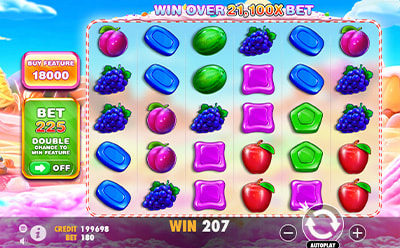
During Free Spins, multiplier bombs remain on the grid until the current tumble sequence ends. Their values are added together and applied to that sequence’s tumble win. This distinction matters: a multiplier is not automatically applied to every spin in the feature, and a bomb has no value if the relevant sequence does not produce a win. Treat the feature as a possibility with variable outcomes rather than as a fixed return.
Which settings deserve the closest attention?
The in-game information screen is the best place to check the configuration loaded by a particular operator. Published versions of the original game have included RTP figures around 96.48% to 96.51%, but the available configuration can differ. The displayed RTP is a long-term theoretical measure, not a short-term guarantee, and it does not show how results will be distributed during one evening or one bonus round.
Stake denominations and bet ranges may also vary between operators and currencies. Choose a stake that allows a session to continue without requiring a win to fund the next spin. A useful test is to decide the maximum amount you are prepared to lose before playing, then select a base bet that does not make that limit disappear after a few unsuccessful spins.
Extra features need separate consideration. An Ante Bet-style option may increase the stake by 25% while adding more Scatter symbols and improving the chance of triggering Free Spins naturally, according to the documented version. Bonus Buy, where permitted, may cost 100 times the selected base bet and can be unavailable depending on the operator or jurisdiction. Neither option removes volatility; both increase the amount exposed to a single decision.
Should you use a demo before risking money?
Demo play is useful for learning the interface, reading the paytable and seeing how the Tumble sequence operates. It can also help you confirm whether the visual style, pace and feature presentation suit your preferences. Because demo credits have no cash value, however, they do not reproduce the financial pressure of real-money play or prove that a particular return rate will appear later.
Use practice mode to answer narrow questions rather than to search for a winning pattern. You can check how the stake selector works, where the RTP is displayed, how Game History is accessed and whether optional controls such as Quick Spin or Autoplay are present. Do not assume that a short run of frequent wins demonstrates low volatility, or that a quiet run proves the game is due to compensate you.
Before switching to real money, compare the loaded rules with your plan. Confirm the stake, RTP, feature availability and any operator-specific restrictions. For broader information about gambling-related risks and support, consult Canadian gambling health information. A demo can improve familiarity, but it cannot establish expected personal results or make a risky stake affordable.
How can Canadian players set a sensible session plan?
Start with a fixed entertainment budget and a time limit. The budget should be money that can be lost without affecting rent, food, bills or other commitments. Divide it into a planned session amount rather than increasing the stake after losses. If the operator provides deposit, loss or session controls, review them before playing because those tools belong to the hosting casino, not the game itself.
Decide in advance what will happen after a winning streak. Volatility can encourage players to raise their stake after a few successful tumbles, but doing so changes the amount exposed on every later spin. A stop point for both losses and wins makes the session easier to control. Never treat a previous win as a reason to chase a larger one or as evidence that a bonus round is approaching.
Keep records if you find sessions difficult to evaluate in the moment. Note the starting balance, planned limit, time spent and ending balance, without using the record to predict future outcomes. If you feel pressure to recover losses, hide play, borrow money or continue beyond your limit, stop and seek support. The most useful volatility strategy is accepting uncertainty before the first spin.
Frequently asked questions
Is a high multiplier evidence of lower volatility?
No. Multipliers can increase the value of a winning Free Spins tumble, but they do not determine how often the feature appears or whether a tumble will win. A 2x to 100x bomb is a possible outcome, not a regular payment, and its presence does not guarantee that the overall round will be profitable.
Can demo results predict real-money results?
No. Demo play uses virtual credits and a short sample cannot verify RTP, volatility or bonus frequency. It is useful for learning controls and rules, but each real-money outcome remains random. Treat practice mode as familiarisation, not as evidence that a particular stake or strategy will produce a return.
Does buying Free Spins remove the game’s uncertainty?
No. Where an operator permits Bonus Buy, the documented price is 100 times the selected base bet, but the feature can be restricted. Buying the round gives access to its spins; it does not guarantee multipliers, retriggers or a return equal to the purchase cost. Check the loaded rules before considering the option.